


Mate: The Beverage of Hospitality, from the Forests of South America to the Gatherings of the Levant
Mate: The Beverage of Hospitality, from the Forests of South America to the Gatherings of the Levant

Editorial Team
- 27 September، 2026
Mate is not just a passing drink; it is a daily ritual and a symbol of hospitality carrying a story spanning centuries across continents. From the subtropical forests of South America, where it originated among the Guaraní tribes, to evening gatherings in Syria and Lebanon, mate remains a beverage that brings people together in a unique tradition unlike any other drink.
What Is Mate?
Mate (Yerba Mate) is an herbal beverage prepared by steeping the dried and ground leaves and twigs of the plant Ilex paraguariensis in hot or cold water. This plant belongs to the holly family and is an evergreen tree native to the subtropical regions of South America, specifically Argentina, Brazil, Paraguay, and Uruguay. Technically, mate is not classified as true tea, but rather as an herbal infusion of the holly type.
Mate contains a caffeine content of about 80 milligrams per cup, roughly equivalent to a cup of coffee. It is also rich in minerals such as potassium and magnesium, vitamins such as C and B, and antioxidants of the polyphenol type.
Original Home and Historical Spread
The origin of mate goes back to the Guaraní tribes who inhabited the regions of Paraguay, Argentina, Brazil, and Uruguay before the arrival of Europeans. These tribes drank mate and used it in their rituals, and even used it as currency for trade with the Inca.
With the arrival of Spanish colonizers in the sixteenth century, mate consumption spread throughout the southern continent. By the seventeenth century, mate had become an essential part of daily life, especially in rural areas.
As for mate’s arrival in the Levant, it dates back to the early twentieth century with waves of migration from Syria and Lebanon to South America. Migrants returned carrying with them the habit of drinking mate, spreading it in their original regions. Sources indicate that Syria is considered the largest importer of mate in the world after the South American countries, importing about 15,000 tons annually.
Types of Mate and Methods of Preparation
Mate preparation methods vary by region and occasion:
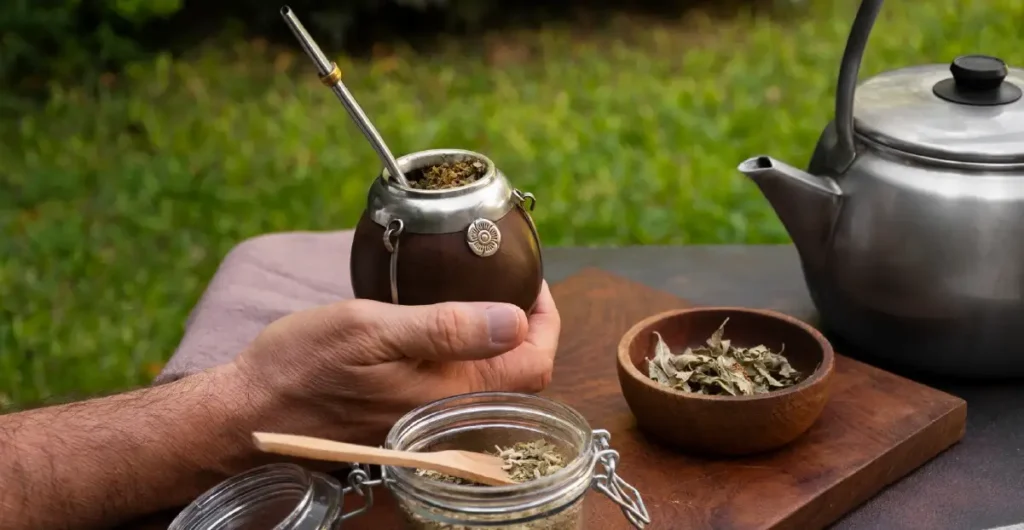
Traditional Mate (Cimarrón): Prepared by placing mate leaves in the traditional vessel (the gourd or “jowza”), then adding hot water, and drinking it using the metal straw called the “bombilla.”
Cold Mate (Tereré): Common in Paraguay and parts of Brazil, prepared with cold water along with herbs or lemon juice.
Cooked Mate (Cocido): Prepared like regular tea, and drunk in a cup with a tea bag.
Chimarrão: A type of green mate prepared with hot water in southern Brazil.
Health Benefits of Mate
Studies indicate that mate contains biologically active compounds that may offer multiple health benefits:
Antioxidants: Mate contains polyphenols that fight oxidative stress and strengthen immunity.
Improving Cholesterol: Some studies indicate that drinking mate may help improve cholesterol levels.
Supporting Athletic Performance: Mate may help increase fat burning during exercise thanks to its caffeine content.
Regulating Blood Sugar: Small studies indicate a potential to improve insulin sensitivity, but more research is needed.
Warnings and Precautions
Despite the benefits, some risks associated with excessive consumption should be noted:
Caffeine Issues: Excessive mate drinking may cause insomnia, nervousness, rapid heartbeat, and stomach upset.
Association with Some Cancers: Studies indicate that people who drink very large amounts of mate (4–8 cups daily) over long periods may be more susceptible to cancer of the mouth, throat, and lungs, especially if they drink it very hot or are smokers.
Drug Interactions: Mate can interact with certain medications and dietary supplements.
Production Challenges
Global mate production is concentrated in Argentina, which is the leading producer and consumer (about 100,000 tons annually), followed by Brazil and Paraguay. Uruguay consumes between 6 and 8 kilograms per person annually, one of the highest rates in the world.
Mate cultivation faces numerous challenges, most notably: the difficulty of seed germination, which requires a full year to sprout, the need for a specific subtropical climate, and high labor costs in picking and processing. Climate changes also affect crop quality and harvest times.
In conclusion, mate remains more than just a stimulating beverage; it is a cultural bridge between continents, and a symbol of hospitality that unites people , from the forests of Paraguay to the mountains of Sweida.